Next week I will be presenting a paper at the American Schools of Oriental Research Annual meeting in Atlanta. The paper's title is "" Kiriath-Jearim (Deir el-'Azhar): Archaeological Investigations of a Biblical Town in the Judean Hill Country" and was co-authored by myself, Boaz Zissu, Oron Schwartz, Gabriel Barkay (my former teacher) and Alexandar Fantalkin. You can view the presentation below.
Showing posts with label Archaeology. Show all posts
Showing posts with label Archaeology. Show all posts
November 10, 2015


February 11, 2011
Guest Blogger: BiblePlaces Blog
For the next month I will be contributing to Todd Bolen's BiblePlaces blog. BiblePlaces is one of the most read archaeological blogs on the internet. Today's post provides the following bio introduction for your faithful servant:
Chris McKinny is finishing up his M.A. thesis at the Jerusalem University College. Last semester he taught full-time at the Israel Bible Extension campus of The Master’s College. Chris has a particular passion for archaeology, and he has spent summers excavating at Tell es-Safi (Gath) and Tel Burna (Libnah?) in the Shephelah of Judah. Chris lives in Jerusalem with his wife Mindy (whose photographic work has been featured on this blog in the past). He blogs occasionally at Seeking a Homeland.
January 12, 2011
Tel Burna Featured in BAR
The recent addition of BAR (Biblical Archaeology Review) chronicles the different active archaeological sites in Israel. Tel Burna, the dig that Mindy and I are involved with is one of the featured sites - see some information regarding Biblical Libnah (?) and it's beautiful cover girl/photographer here.
August 17, 2010
Tel Burna 2010-11 Excavation Season(s)
The dates for Tel Burna's excavation seasons have just been announced. Can't wait to go back for a couple days with IBEX this November to continue work at this fascinating site. You can see some of Burna's fortifications here. Our short season will include a continuation of the surface survey, as well as a clearing of brush around some of the fortification lines.
Here is what Sir William Matthew Flinders Petrie (of headless fame) had to say about the site in 1891 in his journal on Tell el Hesy:

If you look closely you can make out the shape of the tell on its north, west and east sides (oriented due north) - these sides are basically symmetrical and according to Google Earth about 200 ft long. (Google earth is amazing).
 |
| Taken from 1980 Calloway, J. "Sir Flinders Petrie: Father of Palestinian Archaeology," BAR 6/6: 44-45. |
“Tell Bornat – Late Jewish pottery, no Greek (?) or Roman. Top is in crops, the sides half barren. About 200 feet square with long slopes."
Petrie's description was spot on as this is the exact archaeological picture (there were no such designations as EBIV/MBI/IB, LB I, Iron IIa in Petrie's day) we have of Tel Burna with the same dimensions he describes nearly 120 years ago. As confirmed by Google Earth.

August 7, 2010
Tel Burna Slideshow
My lovely wife has put together a phenomenal slideshow of this year's excavations at Tel Burna.
Tel Burna 2010 from Mindy McKinny on Vimeo.
Tel Burna 2010 from Mindy McKinny on Vimeo.
July 17, 2010
Tel Burna's Impressive (Visible) Fortifications
Here are a few looks at Tel Burna's impressive fortifications taken by Sky View. Understand that it is extremely rare to be able to see Iron Age architecture directly on the surface of a tell - especially one that has not been touched by the spade of archaeology (you should hear the giddiness in my voice).

 Needless to say - the possibilities for this site are very tantalizing. You can see some other aerial shots and descriptions at the official blog site of Tel Burna.


June 28, 2010
Tel Burna Excavations
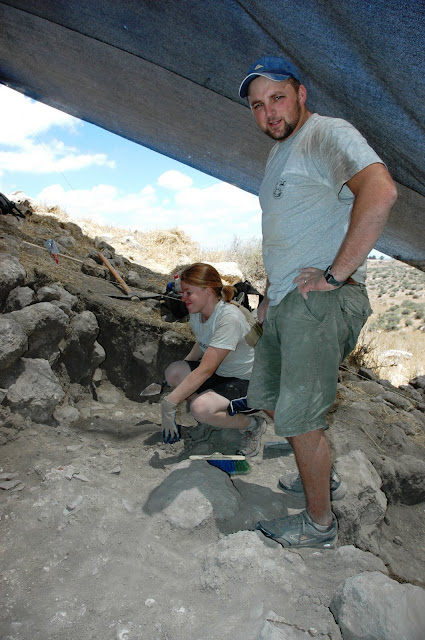
For the last week-and-a-half Mindy and I have been excavating at Tel Burna (also known as Tell Bornat). So far the finds have been numerous and the fun ubiquitous.
You can check out the Tel Burna Excavation at the official website.
and Mindy's blog where she has been posting a lot of pictures of the excavation.



Here is a biblical concordance of Libnah. Note that in order for a site to be Libnah it need have material culture (remains) from each of these periods (unless of course that period was completely robbed out - which sometimes happens.)

You can check out the Tel Burna Excavation at the official website.
and Mindy's blog where she has been posting a lot of pictures of the excavation.

Mindy and I's square for the last week and a half - photos courtesy of Amit Dagam.

Working hard. This is probably a 9th century destruction level - although no one knows how far it will go across the site.

The site of Tel Burna is very interesting - it is in the Shephelah very close to Beth Guvrim/Maresha. It has never been excavated and the Israelite period is directly on the surface (a rarity nowadays). This is the first season of excavation and already the finds have been quite interesting including the discovery of Iron II fortification walls and a 9th century destruction level. Geographically, Burna may be identified with the biblical city of Libnah, which was a border town and Levitical city within Judah (Josh. 15:42; 21:13) on the fringe of southern Judah near Philistia. Two other prominent candidates for Libnah are Tel Goded and Tell Zayit. The excavations at Tel Burna are being carried out under the direction of Drs. Itzick Shai and Joe Uziel.

Here is a biblical concordance of Libnah. Note that in order for a site to be Libnah it need have material culture (remains) from each of these periods (unless of course that period was completely robbed out - which sometimes happens.)

- (ca. 1400 BC - Late Bronze I (according to an Early Conquest view - ca. 1200 BC Late Bronze II for a Late Conquest view) "As for Makkedah, Joshua captured it on that day and struck it, and its king, with the edge of the sword. He devoted to destruction every person in it; he left none remaining. And he did to the king of Makkedah just as he had done to the king of Jericho. Then Joshua and all Israel with him passed on from Makkedah to Libnah and fought against Libnah. And the LORD gave it also and its king into the hand of Israel. And he struck it with the edge of the sword, and every person in it; he left none remaining in it. And he did to its king as he had done to the king of Jericho. Then Joshua and all Israel with him passed on from Libnah to Lachish and laid siege to it and fought against it. And the LORD gave Lachish into the hand of Israel, and he captured it on the second day and struck it with the edge of the sword, and every person in it, as he had done to Libnah.” (Joshua 10:28–32 ESV)
- (Jehoram son of Jehoshaphat ca. 845 BC - Iron IIa) "So Edom revolted from the rule of Judah to this day. Then Libnah revolted at the same time.” (2 Kings 8:22 ESV; see also 2 Chron. 21:10)
- (During the time of Hezekiah ca. 701 BC Iron IIc) "Rabshakeh returned, and found the king of Assyria fighting against Libnah, for he heard that the king had left Lachish.” (2 Kings 19:8 ESV; see also Is. 37:8)
- (ca. 600 BC right before the destruction of Jerusalem - Iron IIc) "Jehoahaz was twenty-three years old when he began to reign, and he reigned three months in Jerusalem. His mother’s name was Hamutal the daughter of Jeremiah of Libnah.”(2 Kings 23:31 ESV)
- (ca. 586 BC right before the destruction of Jerusalem - Iron IIc) "Zedekiah was twenty-one years old when he became king, and he reigned eleven years in Jerusalem. His mother’s name was Hamutal the daughter of Jeremiah of Libnah.” (2 Kings 24:18 ESV; see also Jer. 52:1)
April 16, 2010
BAR Article: The Devil Is Not So Black as He Seems
If you have heard of things like "low chronology vs. high chronology," "maximalist vs. minimilast," liberal archaeology, or the "10th/9th Century debate" and have no idea what to make of them than this article will be a good introduction to the figure-head of most major modern Biblical Archaeology debates.
A couple quick quotes from Hershel Shanks' interview with Israel Finkelstein- one that saddens me a little and another that helps illustrate what is very wrong with Finkelstein and his ilk's interpretations.
The hermeneutical scalpel of history and legend then becomes searching out and cutting through the cancerous tumor of Jerusalem/Davidic/Yahwistic bias in order to find the clean and clear and under-control unbiased historical facts. But - what if - and yes I know I am going to sound crazy for suggesting something so otulandish - what if the Jerusalem/Davidic/Yahwistic bias is historically factual? Does bias make something untrue or even factually flawed? You tell me.
A couple quick quotes from Hershel Shanks' interview with Israel Finkelstein- one that saddens me a little and another that helps illustrate what is very wrong with Finkelstein and his ilk's interpretations.
Shanks: Was there an Exodus from Egypt? (part of a longer question)Everyone does not accept the fact that two million people did not cross the Sinai desert (and yes that is a double negative mom if you are reading this) - perhaps every card-carrying member of the Late Date Exodus theory (13th century) rejects Israel's massive size (although even that is not entirely accurate). Notice that the entire questioning is centered around a 13th century date - not a mid-15th century date - i.e. the Biblical date.
Finkelstein: You should start with a different example, because the Exodus is really a difficult case. I have to really concentrate now because there are many aspects to it. You put a trap. I know you, Hershel, you put a trap here. So I have to be very careful. We know each other, Hershel, 35 years or so. This is an ambush ... But I’m not going to run away. There are many answers to this question. The easiest answer is, “I don’t know.” But I think that one can offer a better answer. But the answer is again not black and white. It’s nuanced. If you are speaking about an Exodus the way it is described in the Biblical text—a very large group of people marching through the desert for 40 years—the answer is “no.”Shanks: Of course; everyone accepts the fact that two million people did not cross the Sinai desert. We don’t need to argue about that.
This is the biggest problem with guys like Prof. Finkelstein (by the way almost all archaeologists would for the most part agree with the statement above - the dissidence comes in the monarchical period) - they assume the absence of textually attested remains and political situations (i.e. archaeological remains and contexts) = the negation of said text. But here is the catch - the only text that applies to is the Bible. If some other "un-biased" historical text, say the Amarna Tablets (13th cent. BCE correspondence between Canaanite city states and Egypt), does not quite match the archaeological record (which is a characteristic of the Amarna tablets and archaeology in many instances) than they get a free pass because they were not an "ideologically" driven document.Shanks: Where did these Israelites come from?Finkelstein: Well, you know my take on this. There were local groups in Canaan in the Late Bronze Age. I don’t want to go beyond what archaeology can tell us. The majority of Israelites came from this local Bedouin-like stock, from the people of Canaan in the second millennium B.C.E. (emphasis mine)
The hermeneutical scalpel of history and legend then becomes searching out and cutting through the cancerous tumor of Jerusalem/Davidic/Yahwistic bias in order to find the clean and clear and under-control unbiased historical facts. But - what if - and yes I know I am going to sound crazy for suggesting something so otulandish - what if the Jerusalem/Davidic/Yahwistic bias is historically factual? Does bias make something untrue or even factually flawed? You tell me.
April 5, 2010
Email Forward Hoaxes
Recently there seems to be a lot of e-mail traffic regarding Biblical "archaeology" apologetics. The two most prevalent email forwards that I have encountered are the "Exodus Route" and the "Giant Skeletons=Nephilim." I have been asked by a few different people about the veracity of the claims laid out in these emails - so here is my answer. The short answer - these "apologetics" are almost always a sham which mix very little truth with a lot of baloney. Concocting a tasty cocktail of flashy images, bad history, and horrible "archaeology" these emails offer up seemingly helpful answers to thirsty Christians. I think my former professor, Todd Bolen, has coined the best principle statement for dealing with email forwards like these - "I might suggest a simple principle for dealing with matters like this in the future: if you heard about it first in an email forward, it’s not true." Both humorous and accurate - always a good combo. Read more about his thoughts on the "Giant Skeletons" here (also see Michael Patton's thoughts on the dilapidated forward here).
In what follows I will attempt to debunk the "Exodus Route" email forward that I have received from a number of different people. For reference you should open the slide show in another window to follow along with my critique - you can do that here.
Sites that are mentioned in the email as historical proofs for the Bible
The Proposed Exodus Route
The first question you have to ask is. "Was it possible for the Israelites to leave Goshen and make it to the proposed crossing and Sinai site in the Biblical time frame?" Generally scholars believe that armies could travel on average 15 miles per day (document from a contemporary source say such - Pharoah Thutmose III). Some Biblical scholars estimate that it took the Israelites 7 days to get to where they crossed the Red Sea (better understood as Yom Suf - Sea of Reeds a tributary of the Red Sea much further inland) (Ex. 13:3,4; 12:33f.; Deut. 16:3; Lev. 23:42-43) others believe that it would have been closer to 9 days (three days at each campsite Succoth, Etham and Migdol). In either case its roughly 100 miles from Pithom and Ramses (where the Israelite started) to Suez city (the traditional crossing point) (7x15 miles = 100 miles). Remember this group of Israelites is estimated at being around 2 million people at this time (by conservative scholars) - and even though they were in a hurry they could not have averaged more than 15 miles per day. The map shown in the PowerPoint adds an additional 200 miles between the leaving of Egypt and the crossing of the Red Sea. If this is the crossing the Israelites would have had to travel around 30 miles a day to get to their crossing point. If the Bible is to be taken literally - which is supposedly the point of this whole PowerPoint - see the last slide - than these claims are not only biblically improbable, but humanly impossible. These proposed theories were made popular among Christians by a former police detective, Ron Wyatt and his two sons in the 1980s.
The Proposed Crossing Point and Alternative for Mt. Sinai
Simply put, its a sham. The golden wheel is a complete fabrication (based on numerous sources from the internet and scholarly articles) of Ron Wyatt's and the other so called wheels and remains are part of the amazing coral reef that runs throughout the Red Sea (in fact the coral reef makes it the second best scuba and snorkel destination in the world behind the Great Barrier Reef in Australia). On the other hand I personally have found a genuine "wheel" in the Red Sea.

Also the proposed Solomon's pillars have zero context with which to label them - they are not inscribed - nor did Solomon ever have dominion over this region never, ever - the furthest domain of Israel in the south is Eilat, which is at the very tip of the Red Sea (where I found the "wheel" that has just as much legitimacy to the claims of Ron Wyatt). The main problem with all these theories is that most of his assertions provide zero archaeological context, meaning that they are either untraceable as far as their date or that the archaeological context is completely ignored. The core of archaeology is dating - the main tool for dating is pottery (inscriptions are very rare and sometimes are inconclusive for dating). The one place where there actually is legitimate archaeological remains is at the proposed site of Mt. Sinai (Jebel al Lawz) and the vast majority of pottery is Nabatean (2nd cent B.C.E. (B.C.) - 3rd Cent. C.E. (A.D.)) much, much later than the 1400 B.C.E. Exodus. As far as his claim that the split rock at Mt. Horeb is the one in the picture - it's just ridiculous - the area of the Arabah (Southern Israel, Southwestern Jordan, and Western Saudi Arabia) is one of the most geologically diverse places on the globe. I have personally seen dozens if not hundreds of rocks similar to that in sandstone areas such as the Wadi Rum (Jordan - of Transformers 2 fame) and the Sinai Peninsula.


The Real Problem with Bad Christian Apologetics
This PowerPoint is in the vein of the mass emails about the missing days in the universe being attributed to Joshua causing the sun to stand still and other emails like it directed at the emotions of well-intending American Evangelicals who have no clue about archaeology (I don't say that pretentiously - most people are not privy to archaeological theory - and even good Biblical scholars are lead away by these theories). That is where the real harm is done in these emails and other so-called "Bible Proofs" - because well-meaning believers take these type of things and seek to argue for the historicity of scripture using these as their proofs - they are basing their faith on a very sandy foundation and have given atheists and biblical critics (who are "in the know") a way of poking fun at the Bible. It can shake the faith of a young believer who is shown that this is a sham, much like a new believer's faith can be shaken whenever he sees that Benny Hinn's healings are a crock.
Truthfully, the only truth embedded in this PowerPoint is the first picture which identifies the well of Sychar as being Jacob's well - this identification is well-attested and has good standing in both tradition, text, and archaeology, but is hardly a basis for proving the Bible's veracity.
If you want to look at it more here is an article discussing the the Exodus route and the various options for Mt. Sinai.
In what follows I will attempt to debunk the "Exodus Route" email forward that I have received from a number of different people. For reference you should open the slide show in another window to follow along with my critique - you can do that here.
Sites that are mentioned in the email as historical proofs for the Bible
- Jacob's Well - I just recently visited this well in Nablus (biblical Shechem). The well's identification as being from John 4 is probably accurate since the region of Shechem has a very low-water table - there are very few wells in the region since there are abundant springs throughout the region. Also the tradition for the well being that of John 4 dates as far back as the 3rd century A.D. (CE).
- Rachel's Tomb - this tomb has very heavy political implications because it is in Bethlehem and the Orthodox Jews consider it to be a holy place. It matches Genesis 48:7 which basically says that Rachel was buried in Bethlehem. However, there is one major problem the tomb in the picture and the tomb there today are a Bedouin Sheik's tomb, in the neighborhood of 2500-3000 years later than the 2nd millenium B.C.E. event.
- Joseph's Tomb - is also in Nablus (not visitable) - based on what I have been told about the tomb from professors and from the picture in the powerpoint it is quite clear that the tomb is of a Bedouin sheik and not from the Biblical period (compare it with Rachel's tomb).
- Amram's Tomb - not sure where this is or to how to properly identify what exactly it is. I googled "Amram's Tomb Moses Father" - and I found nothing, no pictures, no webpages - other than sites that referenced the slide in the powerpoint which says, "moses must have loved his father very much! It's the longest tomb in the world! My guess is that this is also a Muslim related tomb that has been traditionally attributed to Amram (this happens alot - all over the place).
- Aaron's Tomb - Petra is a possible location for the burial of Aaron (its in the same region), but once again the tomb shown is the tomb of a Bedouin Sheik (you can tell by the architecture - the dome and the brick layout - this is medieval architecture).
The Proposed Exodus Route
The first question you have to ask is. "Was it possible for the Israelites to leave Goshen and make it to the proposed crossing and Sinai site in the Biblical time frame?" Generally scholars believe that armies could travel on average 15 miles per day (document from a contemporary source say such - Pharoah Thutmose III). Some Biblical scholars estimate that it took the Israelites 7 days to get to where they crossed the Red Sea (better understood as Yom Suf - Sea of Reeds a tributary of the Red Sea much further inland) (Ex. 13:3,4; 12:33f.; Deut. 16:3; Lev. 23:42-43) others believe that it would have been closer to 9 days (three days at each campsite Succoth, Etham and Migdol). In either case its roughly 100 miles from Pithom and Ramses (where the Israelite started) to Suez city (the traditional crossing point) (7x15 miles = 100 miles). Remember this group of Israelites is estimated at being around 2 million people at this time (by conservative scholars) - and even though they were in a hurry they could not have averaged more than 15 miles per day. The map shown in the PowerPoint adds an additional 200 miles between the leaving of Egypt and the crossing of the Red Sea. If this is the crossing the Israelites would have had to travel around 30 miles a day to get to their crossing point. If the Bible is to be taken literally - which is supposedly the point of this whole PowerPoint - see the last slide - than these claims are not only biblically improbable, but humanly impossible. These proposed theories were made popular among Christians by a former police detective, Ron Wyatt and his two sons in the 1980s.
The Proposed Crossing Point and Alternative for Mt. Sinai
Simply put, its a sham. The golden wheel is a complete fabrication (based on numerous sources from the internet and scholarly articles) of Ron Wyatt's and the other so called wheels and remains are part of the amazing coral reef that runs throughout the Red Sea (in fact the coral reef makes it the second best scuba and snorkel destination in the world behind the Great Barrier Reef in Australia). On the other hand I personally have found a genuine "wheel" in the Red Sea.

A "wheel" at the depths of the Red Sea

Let's just say that it looked shallower than it was - but once you're soaked you might as well go for it.

I received the reaction Ron Wyatt should receive.
In short - Ron Wyatt is the Benny Hinn of Archaeologists - he is a charlatan who plays on the emotions and good intentions of American Evangelicals. Not surprisingly he has also claimed to have found the Ark of the Covenant, the location of Noah's Ark, the charred remains of Sodom and Gomorrah along with the real Mt. Sinai (what else is there left to find?). I read three of his books in high school - he is a provocative writer that claims to be a better archaeologist than Indiana Jones. Truthfully, there is more legitimacy to the finds of Indiana Jones than there is Ron Wyatt's - at least Henry Jones Jr. found the Ark of the Covenant and the Sacred Grail in an archaeological context and at least he was a "Dr." and a professor of archaeology! It takes more to be an archaeologist than being good at detective work and a good writer. It takes years of careful study of history, stratigraphy (levels of remains - mainly pottery), philology (study of ancient languages), historical geography, the history of research, and many other sub-disciplines - Wyatt has zero training, zero qualifications, but yet all the answers. Moreover, the goal of archaeology is not to prove the Bible to be true, but to illuminate it. My archaeology professor (Gabi Barkay) says that the Bible does not need archaeology it can stand alone on its own merits. He is exactly right - the goal of archaeology is to understand the world of the ancients, to understand what a specific object meant to a specific people. This type of work is not archaeology its speculation that seeks to prove something that is by its very nature unprovable. Understand me though - although archaeology cannot provide definitive proof that the Bible is 100% percent true, that its inspired, that it is 100% historical - it can provide proof to much of what the Bible speaks of. For instance much of higher critical theory has claimed that the persons of David and Solomon never existed - in the last 30 years two inscriptions have been found one in Israel and one in Jordan that mention the "house of David" referring to the line of kings of David - providing substantial proof that David was in fact a real person and that he lived during the time that the Bible describes. The Real Problem with Bad Christian Apologetics
This PowerPoint is in the vein of the mass emails about the missing days in the universe being attributed to Joshua causing the sun to stand still and other emails like it directed at the emotions of well-intending American Evangelicals who have no clue about archaeology (I don't say that pretentiously - most people are not privy to archaeological theory - and even good Biblical scholars are lead away by these theories). That is where the real harm is done in these emails and other so-called "Bible Proofs" - because well-meaning believers take these type of things and seek to argue for the historicity of scripture using these as their proofs - they are basing their faith on a very sandy foundation and have given atheists and biblical critics (who are "in the know") a way of poking fun at the Bible. It can shake the faith of a young believer who is shown that this is a sham, much like a new believer's faith can be shaken whenever he sees that Benny Hinn's healings are a crock.
Truthfully, the only truth embedded in this PowerPoint is the first picture which identifies the well of Sychar as being Jacob's well - this identification is well-attested and has good standing in both tradition, text, and archaeology, but is hardly a basis for proving the Bible's veracity.
If you want to look at it more here is an article discussing the the Exodus route and the various options for Mt. Sinai.
August 13, 2009
The Mesha Stele as an Archaeological Artifact and Historical Document
This upcoming semester I will be researching and preparing for my Master's thesis. My planned topic is "The Geopolitical Climate of the Reign of King Jehoshaphat of Judah." The following short paper that I finished last semester was instrumental in helping me decide on this topic. The reign of king Jehoshaphat is a fascinating period in the kingdom of Judah that connects all of the small nations of the Levant (present-day Israel, Jordan, Syria, Lebanon, and part of Turkey) I will probably be blogging on this topic more in the future.
Physical Description
The Mesha Stele (or the Moabite Stone) is a three feet tall by two feet wide basalt stone from biblical Dibon incised with 34 lines of alphabetic writing on one side of the stele with a raised frame surrounding it on both sides and on its rounded top. Its length makes it the longest monumental inscription ever found in Palestine.[1] The writing is in Moabite, which is very close to Hebrew.
Discovery
It was first discovered on August 19, 1868 by a French Anglican minister named, F.A. Klein, in Dhiban, Jordan, about three miles north of the Arnon River. [2] Klein discovered it while visiting a Bedouin tribe at Dhiban, when he saw it he understood it to be an importance artifact and tried to purchase it from the Bedouin. After some ensuing bargaining the Bedouin agreed to sell it for 120 napoleons (about $480) with the backing of the Prussian government. Despite the agreement local Bedouin politics would not allow the stone to be shipped out of Dhiban. Over a year later 21-year old Charles Clermont-Ganneau would send an Arab friend to Dhiban to establish its importance who would return with a hand copy of seven lines of the stone. Once Clermont-Ganneau received this he dispatched another Arab friend, named Karavaca, to take a paper squeeze and to offer a much higher sum than had been offered previously. The Bedouin of Dhiban agreed to this so Karavaca began to make the paper squeeze. Meanwhile, a fight broke out among the Bedouin and Karavaca feared for his life so he jumped on his horse and ran away. During the quarrel Sheik Jamil had the wherewithal to tear off the wet impression before scurrying away from the scene. Finally after numerous attempts to take the stone by the Turkish government and the Prussian government the Bedouin destroyed the stele. They broke it into countless pieces by pouring cold water on it after it had been heated in a fire. The fragments were then distributed among the Bedouin who put it in their granaries to be used as a talisman. After its destruction Clermont-Ganneau and Charles Warren were able to obtain 57 pieces of the stele, approximately 2/3’s of the stele. With the paper squeeze Clermont-Ganneau was able to fully reconstruct the stele. When it was translated it turned out to be a victory stele erected by Mesha, king of Moab in the ninth century BCE.[3]


Restoration
The line of “house of David” in the famous Tel Dan inscription was accepted by the majority of the scholarly community to be a reference to the dynastic kingdom of Judah and the person of David. This monumental discovery was hailed as being the first mention of the name of David in an inscription. However, two years prior to its discovery Andre Leimare had already come to believe that the dynastic term “house of David” was on the Mesha Stele, another stele from the 9th century BCE. He came to this conclusion by studying the paper squeeze that had not been published previously.[6] On the evidence for coming to his conclusion Lemaire writes,
“One of the damaged lines has long posed an intriguing challenge to scholars. Line 31 on the stela begins by saying, “And as for Horonen, dwelt there … ,” but a break has partially obliterated the subject of the sentence. With the help of the squeeze, scholars had previously restored the broken subject of the sentence as bt[-]wd. Now, for the first time, Professor Lemaire proposes to reconstruct the missing letter as d, yielding bt[d]wd, “House of David,” referring to the king of Judah. This not only fits the context of the inscription, but the sentence structure parallels an earlier reference in the inscription to the “king of Israel.” In the Bible, “House of David” often refers to the king of Judah (2 Samuel 7:26; 1 Kings 2:24, etc.).”[7]
This groundbreaking restoration gives another mention of the name “David” and improves the understanding of the context on the Mesha Stele.[8]
Historical and Geographical Significance
Besides the obvious historical significance of the mentioning of the name of David, the Mesha Stele provides detailed data regarding the relations between Judah, Israel, and Moab.[9] The opening line of the stele identifies the inscription’s author as it says, “I am Mesha the son of Chemosh king of Moab, the Daibonite. My father reigned over Moab thirty years and I reigned after my father…”[10] 1 Kings 3:4-5 mentions this Mesha king of Moab who rebelled against Israel who had previously required from Moab “100,000 lams and the wool of 100,000 rams.” The Mesha Stele goes on to describe Mesha’s military successes against Judah and Israel. He mentions that his father was under the dominion of Omri and “his son” for forty years. Their holding of the “land of Medeba” (the plateau situated between Moab, Ammon, and Israel) evidenced this. Mesha goes on to say that during his days Chemosh had returned Medeba to Moab and he rebuilt Baal-maon and Kiriaten.. Mesha then proceeds to discuss his military exploits these include the following:
Northern Campaign
1. Conquering of Ataroth from the men of the tribe of Gad, and the confiscating of the Davidic altar hearth there.
2. Seizing and slaughtering of Nebo, and the confiscating of the altar hearth of YHWH.
3. Conquering of the recently Israelite fortified city of Yahaz (which he added to the kingdom of Daibon).
Building Projects
1. Fortification of Dibon, which included: “the wall of the forests,” “the wall of the rampart,” gates, towers, a royal palace, a water system (with Israelite POWs), and cisterns in every home.
2. Rebuilding of Aroer, the highways in the Arnon, Beth-bamoth, Bezer, the temple of Medeba, the temple of Diblaten, and the temple of Baal-maon.
Southern Campaign
1. Conquering of Hawronen from the “House of David.”[11]
There is has been quite a bit of debate regarding the mentioning of the tribe of Gad and the two altar hearths ascribed to David and Yahweh. Even so a straightforward reading of the text seems to indicate that there were altars at Ataroth and Nebo devoted to the worship of Yahweh of which one of these was built by David or his line and that the tribe of Gad still had a remnant in Transjordan in the time of Mesha (9th cent.).[12] Regardless of one’s view of its particular contents it is impossible for anyone to deny its importance as a historical and geographical source. On the importance and nature of the Mesha Stele Ahituv writes,
“The Mesha Stele is important for the abundant of multifaceted details it preserves. It elucidates in relatively large measure the details of the military actions of Mesha king of Moab, contemporary with Ahab king of Israel and Jehoshaphat and Jehoram, kings of Judah, as well as his building projects over an extensive period of time. It would appear that the inscription is a summary of Mesha’s actions up to the date of its writing. It addition to the historical data provided, it is the main witness to the Moabite language. It also gives important insights into the religion and religious attitudes of the Moabites in that period. This includes many points of similarity between the Moabites and their neighbors, the Israelites: the ritual devotion to destruction, the belief that the deity is angry with his people when things go wrong, or that he fights on behalf of his people. The stela also casts light on the world of the Israelites, e.g. we learn about a sanctuary to YHWH at Nebo”[13]
Much ink has been spent on trying to correlate the events described in the Mesha Stele (particularly line 31 ff.) and the events described in 2 Kings 3:4 ff. However, it seems best to see the war between Moab and the coalition of Judah, Israel, and Edom and Mesha’s account as two sides of the same coin. Joram of Israel could not stand for Mesha’s insubordination and outright rebellion as show in 2 Kings 3:4-5 and the Mesha Stele, so he had to take drastic measures. Likewise Jehoshaphat and the “ruler of Edom” could not afford rebellion from Mesha, who had already earlier tried to invade Judah with the help of Ammon (2 Chr. 20). At first the allies were successful in their invasion of Moab (2 Kings 3:24-25), but eventually they were repelled and Mesha counter-attacked and re-conquered Hawronen (Horonaim). This would fit both the biblical account Mesha’s account while leaving out details that were not relevant to the respective audiences of Mesha and the writer of Kings.[14] Rainey defends this position this way,
“There is no contradiction between the biblical and the Moabite narratives: they simply represents different sides of the same event. Naturally, Mesha has conveniently skipped over his abortive attempt to launch a joint invasion of Judah (2 Chron. 20). That ill-fated campaign followed the death of Ahab at Ramoth-gilead (before Jehoshaphat and Ahaziah launched their nautical enterprise) and preceded the war described in 2 Kings 3 (when Joram had succeeded his deceased brother Ahaziah).”[15]
[1] Andre Lemaire, “‘House of David’ Restored in Moabite Inscription.” BAR vol. 20 num. 3 (1994): 30-37.
[2] Siegfried Horn, “Why the Moabite Stone was Blown to Pieces,” BAR (1986): 50-61.
[3] Adapted from Horn, 50-61 and Leimare, 30-37.
[4] Reconstructed Mesha Stele from the Louvre Museum Ibid, 51.
[5] Paper squeeze from the Louvre Museum Ibid, 36.
[6] Adapted from Lemaire, 30-37.
[7] Ibid, 36.
[8] Ibid, 30-37.
[9] For a translation and discussion of the Moabite in the Mesha Stele see Shmuel Ahituv, Echoes from the Past: Hebrew and Cognate Inscriptions from the Biblical Period, (Jerusalem: Carta, 2008). 389-418.
[10] Translation taken from Anson Rainey and Steve Notley, The Sacred Bridge: Carta’s Atlas of the Biblical World, (Jerusalem: Carta, 2006): 203. Transliteration and other marks are not included.
[11] Adapted from Ibid, 211-212.
[12] For a discussion and in depth analyses on these very important issues see Anson Rainey, “Syntax, Hermeneutics and History,” IEJ 48 (1998), 244-251. Rainey summarily defends this position like this, “In summary, the reference to bt dwd in line 31 of the Mesha stele certainly refers to the kingdom of Judah. The ‘altar hearth’ taken as booty from Ataroth had beed donated to the Israelites from the tribe of Gad by David, or at least by the government of the United Monarchy. That these assertions shed positive light on the biblical sources for the tenth and ninth centuries BCE makes them automatically suspect in some circles. Nevertheless, these interpretations can all be supported by syntactical and rhetorical criticism of the text. They represent sound linguistic analysis, proper rhetorical hermeneutics and historical common sense.”
[13] Ibid, 389.
[14] Ibid, 250.
[15] Ibid, 251.
Subscribe to:
Posts (Atom)